A Different Story for Knitting: Revisiting a Concept from the Past (a short reflection of process)
Themes
creative problem solving
mindset
efficacy
design process
Interdisciplinary design
mixed media textiles
product development
mistakes and serendipity
The Meta Creativity Model
discipline
stereotypes
craft and the handmade
This project grew out of my passion for the knitting process itself and my desire to push it beyond its familiar boundaries. While studying textile design at university, I became interested in how knitting works; the logic of the loop, the construction of a fabric and the way structure emerges through repetition. At the same time, I wanted to challenge the dominant narratives around knitting and move away from its common associations with nostalgia or domestic craft; aka 'the granny knit'.

My aim with this project was to create a different story for knitting, one that focuses on the engineering of fabrics, structures, and forms. I began to see knitting not just as a textile technique, but as a system for building material and spatial outcomes.
The motivation driving this project was to reposition knitting outside of fashion and apply it to new contexts.
Returning to this idea now feels uncertain — I don’t know if it will work, and there isn’t a clear outcome mapped out in advance. What has been important for me in this process is trusting my original conviction and allowing the work to unfold through prototyping and making.
I’ve deliberately embraced a sense of not knowing, using the studio as a space to test, respond, and problem-solve as issues arise. Serendipity has become part of the process, with unexpected results often guiding the next decision rather than a fixed plan. Working this way has reminded me that experimentation, risk and adaptability are central to how I design, and that learning often happens through the act of making rather than through certainty.
The knitted structure

I measured the wales and courses needed to fit the window and adjusted the knitting direction to work within the machine’s fixed width. The width constraint led me to design the knit to run horizontally across the window and produce three identical panels, which I would later link together, unobtrusively along a wale, to achieve the required length.

This is the amazingly quick park of the process


I explored the mechanisms of how the blind functions, moving through ideation, experimentation and prototyping. I also considered the placement on the window, testing different arrangements to find the most effective solution.
The Big Weave

Weaving the slats into the knit took up the bulk of the time, with two blinds to make; each having over 50 weave sections but it was an enjoyable time.
My back definitely felt it, but the process was surprisingly absorbing. Taking this time allowed me to slow down and really engage with the work, giving me space to reflect and experiment. I found new and better ways to approach the weaving, and the discipline and determination required reminded me of the creative problem-solving mindset I started the project with. The slow pace also offered unexpected benefits: it gave me rest from my day job, allowed my brain to wander, and opened up insight into other challenges in my life.
Working this way reinforced many of the original themes I’ve been exploring — the design process, inspiration, efficacy, interdisciplinary applications, mixed-media textiles, craft and the handmade (more of this is covered in the short film accompanying this post)
Serendipity played a big role in guiding iterative experimentation....

.....case in point being the DIY shuttle
The challenge was to find a tool slim enough to pass through the knitted channels , while running smoothly, to speed up the process. After testing options, a slim ruler (sourced exclusively from my local bits and bobs shop) proved ideal and with a hacksaw and some sandpaper, it was adapted into a functional shuttle. I consider this to be the meta-creativity model in action; combining experimentation, lateral thinking and resourcefulness and highlighting how intuitive problem-solving can lead to both planned and serendipitous outcomes.
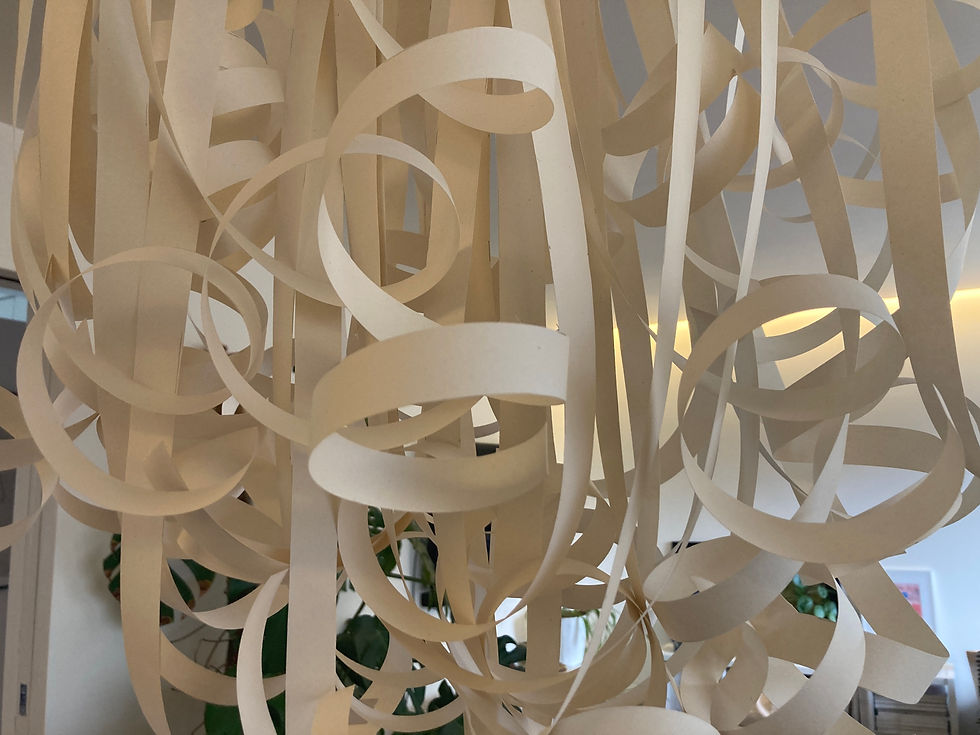
Working the strips by hand, I began with a craft knife, metal ruler, and cutting mat to keep the widths consistent but this method quickly proved slow.
Switching to scissors made the process more efficient, yet the natural inconsistencies of hand-cutting started to shape the work. I had to negotiate the balance of precision, speed and handmade quality of the fabric.
The resulting strips revealed an unexpected visual appeal, highlighting the value of making, as a tool for discovery and creative problem-solving.
This tension proved productive and aligned with the iterative focus of the project; exploring how knitting works - how structure emerges through repetition while challenging its usual associations with domestic craft. The limitations of working by hand, created space for reflection and experimentation, showing how material constraints can generate new insights and reinforce both the structural and conceptual ambitions of the project.
This project reminded me why I value making as a way of thinking. Working through uncertainty, constraints, and small decisions revealed new possibilities in the material and in my own process. The blind became a site for experimentation, problem-solving, and reflection, reinforcing my interest in structure, repetition, and knitting as a system rather than a craft stereotype. Seeing the idea through from start to finish is more important than the final outcome.
A different take on the project process can be seen in this short film:
The outcome is a new prototype window blind, entirely handmade and custom fitted to the space, intuitively combining a knitted structure with woven slats. It diffuses the suns rays to create a warm atmosphere in the room. The materials are natural linen yarn, left over from previous sampling and undyed lining paper. The blind mechanism is handmade and materials were purchased from local DIY stores.


Comments